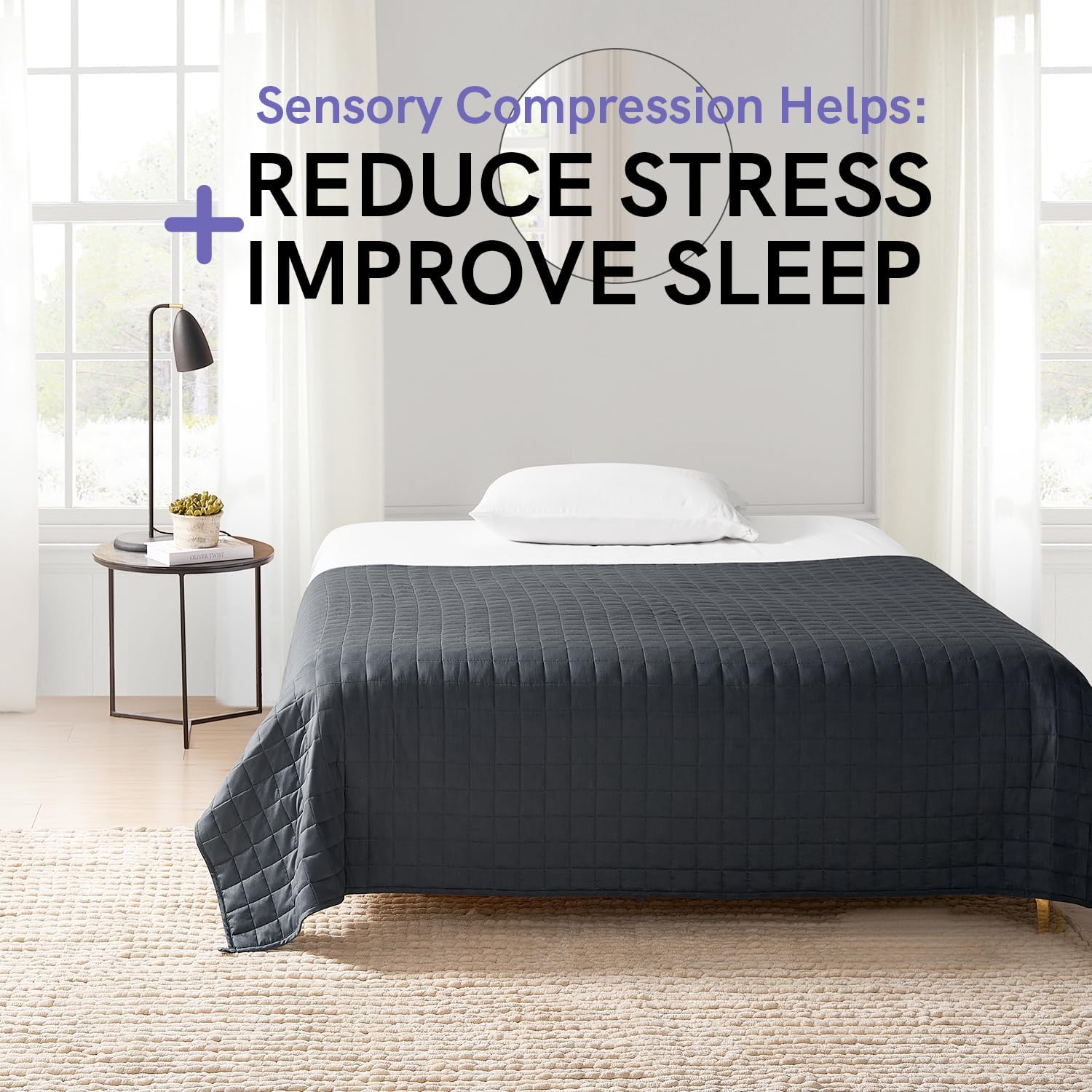
A weighted blanket is exactly what it sounds like: a blanket filled with small weighted beads or pellets — usually glass or plastic — sewn into internal pockets so the weight distributes evenly across the body. The idea is that sustained, even pressure across a large body surface activates what occupational therapists call deep pressure input (also called deep touch pressure, or DTP) — a sensory signal that calms the nervous system in much the same way a firm hug does. For children with autism spectrum disorder or sensory processing differences, weighted blankets have been a clinical staple for two decades. What has lagged is the adult application — and that gap creates both a clinical opportunity and a sourcing headache, because most product lines are still engineered, marketed, and weight-ranged around pediatric users.
If you are an occupational therapist, a school-to-adulthood transition coordinator, or a home-clinic practitioner now fielding requests from adult clients with anxiety, ADHD, or sensory processing disorder (SPD), this guide is calibrated to your decision frame. You already know what DTP is. What you need is a clear spec comparison, the weight-selection math for adult bodies, a candid look at sensory avoider contraindications, and a decision rule you can act on today.
Why the Pediatric Dosing Formula Breaks Down for Adults
The most widely cited starting guideline — use a blanket equal to roughly 10% of the user’s body weight — comes from practitioner consensus and has been repeated so often it reads like established protocol. It isn’t. The AOTA’s practice guidelines (referenced in their 2019 autism guidance document) frame the 10% rule as a clinical starting point, not a prescription, and note that individual sensory profiles, body composition, and temperature regulation all affect tolerance.
For adults, this matters because the math compresses at higher weights in ways it doesn’t for children:
By the numbers:
| Body weight | 10% rule target | Practical blanket options |
|---|---|---|
| 120 lb (54 kg) | 12 lb | Well-served by standard adult line |
| 160 lb (73 kg) | 16 lb | Upper edge of most consumer product lines |
| 200 lb (91 kg) | 20 lb | Few off-the-shelf options; custom or bariatric required |
| 250 lb + (113 kg +) | 25 lb+ | Almost no consumer products; clinical-grade or custom only |
Most consumer weighted blankets top out at 20–25 lb, and at the high end the construction quality drops sharply — lighter fill concentrations cause bead migration, internal tie-off failures, and hot spots. For larger adult clients, the clinical calculus often becomes: go lighter and add a second layer rather than chasing a precise 10% match in a single product.
Per a 2017 systematic review published in the American Journal of Occupational Therapy (Gee, et al.) on deep touch pressure interventions, effect sizes for anxiety and arousal regulation are meaningful but highly variable — variation attributable to both the individual’s sensory threshold and the quality of pressure distribution, not just blanket weight. A poorly constructed 20 lb blanket with uneven fill delivers worse DTP than a well-made 15 lb product.
Fill Material, Construction Grade, and Temperature: The Three Specs That Actually Matter
Fill Material
Glass beads are the current clinical standard for adult-use blankets. They’re denser than plastic poly pellets, which means a given weight can be achieved with less bulk — the blanket lies flatter, conforms better, and dissipates heat faster. For adults with anxiety who also report temperature sensitivity (a common co-occurrence in sensory processing disorder), fill density-to-weight ratio is a material clinical variable, not a lifestyle preference.
Plastic poly pellets remain common in consumer-grade products because they’re cheaper. They produce a lumpier fill distribution, tend to retain more heat, and are noisier when the user moves. Owners in aggregated reviews consistently describe poly-pellet blankets as feeling “beachy” or “granular” under the fingers — tolerable for some sensory seekers, aversive for sensory avoiders and tactile-sensitive users.
Steel shot beads appear in some heavy-duty or bariatric products. They’re more uniformly spherical than glass, but the acoustic signature (a low metallic click) is an issue for clients with auditory sensitivities.
Construction Grade: Pocket Size and Tie-Off Count
The internal grid of sewn pockets that holds fill in place determines whether weight distributes evenly. Smaller pocket squares (4” × 4” or less) maintain more uniform DTP across the body surface; larger squares (6” × 6” or more) allow bead clustering under gravity. For clinical prescription, look for construction specs on file — reputable therapeutic-grade suppliers will provide these. Consumer brands rarely publish pocket dimensions; when they don’t, treat that as a quality signal.
Tie-off count refers to how many internal stitching points anchor the fill pockets to the outer shell. Higher tie-off counts mean the blanket survives repeated washing without structural failure. Adult blankets in institutional settings (transition programs, residential facilities) get washed frequently; construction durability is a TCO (total cost of ownership) variable that consumer-product review sites consistently underweight.
Temperature Regulation
Adults — particularly adults managing anxiety, menopause, or autonomic nervous system dysregulation — are significantly more heat-sensitive under weighted blankets than children. Bamboo-viscose and cotton-percale covers dissipate heat better than minky (plush polyester) covers. For clients who describe feeling “trapped” or “overheated” under a standard blanket, a cooling-cover configuration is often the difference between sustained use and abandonment. The clinical outcome you’re tracking isn’t whether the blanket is prescribed — it’s whether the client actually uses it.
Sensory Avoiders, Anxiety Subtypes, and the Contraindication Frame
Here is the tradeoff that doesn’t get named often enough: weighted blankets are a deep pressure tool, and deep pressure is not universally calming — it is calming for sensory seekers and many anxious individuals with hypoactive (under-responsive) tactile systems, but it is activating or aversive for sensory avoiders with hyperactive (over-responsive) tactile systems.
This distinction matters clinically. A client presenting with generalized anxiety disorder and a history of trauma may have a hyperactivated tactile system where any firm, inescapable pressure increases arousal rather than decreasing it. The AOTA’s practice framework for sensory-based interventions (outlined in their 2019 autism guidance and broader sensory integration literature) is explicit that sensory modulation interventions require individualized sensory profiling before prescription.
Practical screening questions before recommending a weighted blanket to an adult:
- Does the client seek or avoid firm hugs and physical pressure in daily life?
- Does tight clothing feel comforting or aversive?
- Does the client report claustrophobia or a need to move freely during sleep?
- Is there a history of trauma with physical restraint components?
A “no, no, yes, yes” pattern is a contraindication pattern. Pressing forward with a weighted blanket recommendation without addressing these is a clinical error, not a product selection error.
CHADD’s resource library on ADHD and sleep notes that for adults with ADHD, sleep-onset difficulty is frequently driven by hyperarousal rather than anxiety per se — and the DTP response in this population is inconsistent. Some owners report dramatic improvements in sleep latency (how quickly they fall asleep); others report feeling more alert under the blanket. Per CHADD’s guidance, monitoring outcomes and adjusting within 2–3 weeks is the recommended protocol.
Product Tier Map for Adult Prescription
This is not a product review — it’s a sourcing framework. Specific products are recommended below with tier markers to assist budget-bracketed decisions.
Consumer / family-buyer tier ($60–$150): Adequate for adults in the 120–160 lb range who want a first trial before committing to a clinical-grade product. Glass-bead fill is available at this price point from several established brands; avoid poly-pellet products for adult therapeutic use. Owners of products in this tier consistently report satisfaction on comfort but note durability issues after 12–18 months of daily use.
Mid-tier / prosumer ($150–$300): The optimal range for home-clinic OTs prescribing for individual adult clients. At this price point, construction grade improves meaningfully — smaller pocket squares, higher tie-off counts, and cooling-cover options are reliably available. This tier aligns with what therapeutic equipment suppliers like Fun and Function stock as their adult-facing SKUs.
Clinical / institutional tier ($300+): Relevant for residential facilities, transition programs, and OT clinic settings where washability, load durability, and documentation of construction specs are procurement requirements. Abilitations and FlagHouse both carry clinical-grade adult weighted blankets in this range; FlagHouse’s institutional catalog (as of May 2026) includes options with published pocket-grid specifications and commercial-laundry-rated outer shells.
The Decision Rule
If your client is an adult sensory seeker or anxious sleeper with no contraindication flags and a body weight under 160 lb → start with a mid-tier glass-bead product in the 12–15 lb range, cooling cover if temperature sensitivity is present, and re-assess at 3 weeks.
If your client weighs over 200 lb → do not chase the 10% rule with a single heavy blanket; source a 15–20 lb clinical-grade product and layer if needed. Construction integrity at high weights in consumer products is unreliable, per published-spec comparisons across supplier catalogs.
If your client screens as a sensory avoider or has trauma history involving physical restraint → weighted blanket is not the first-line tool. Consider a lap pad (smaller surface area, lower total weight, more client control) or a compression vest as a less enveloping alternative before attempting a blanket.
If you are sourcing for an institutional setting with laundry cycling more than twice per week → specify institutional-grade construction explicitly in your RFP language and request tie-off count and pocket-grid documentation from the vendor. Consumer products will fail in this use pattern regardless of initial quality.
The adult weighted blanket market has matured enough that good options exist at every price tier — but the pediatric-default framing of most product marketing still obscures the specs that matter most for adult sensory and anxiety applications. Knowing what to ask for is more than half the work.