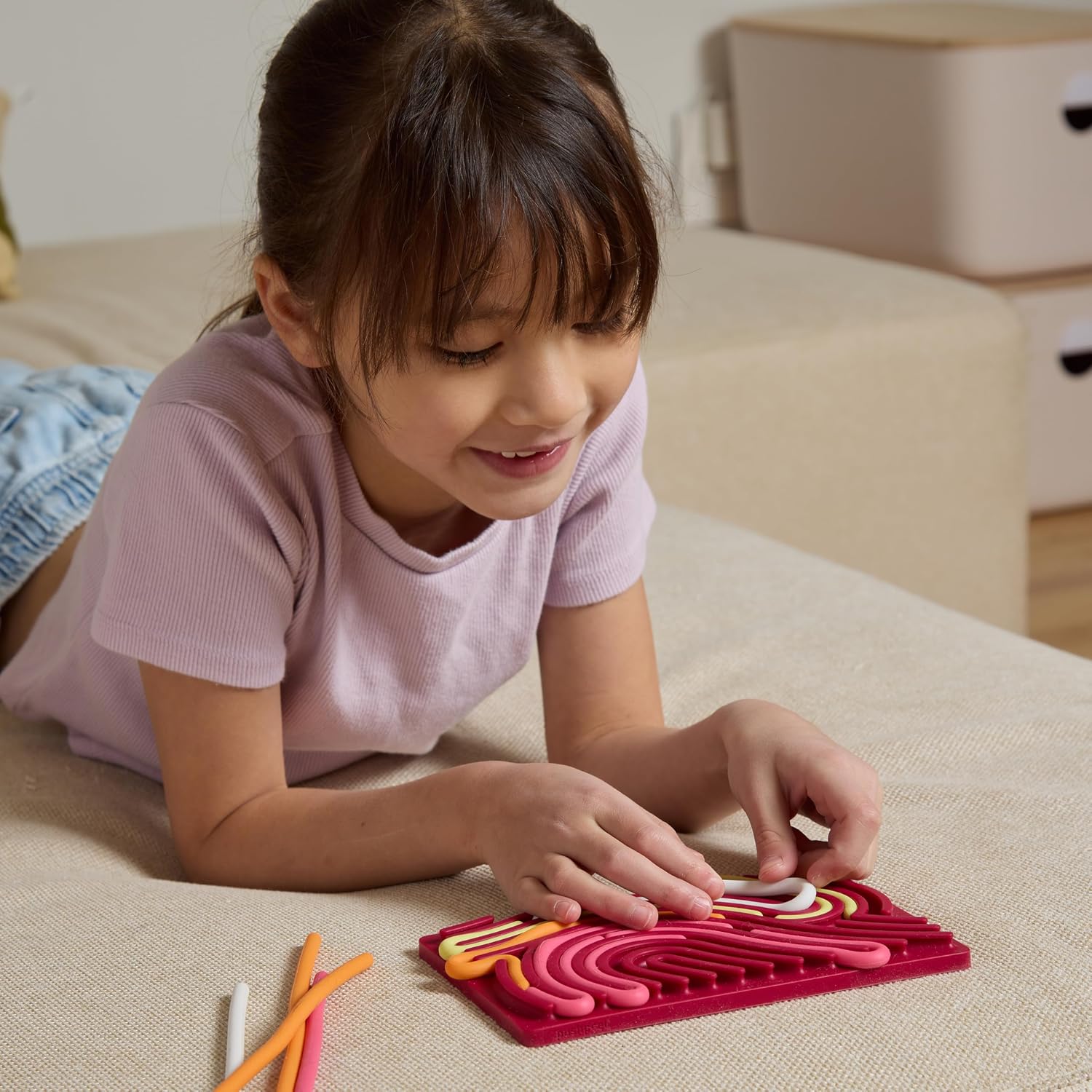
Fidget tools are often treated as a single category — a grab bag of spinners, putties, and chewables that get stuffed into a therapy kit or sent home with a child who “needs something to do with their hands.” But sensory-seeking behavior (the drive to actively pursue extra sensory input because the nervous system isn’t getting enough of what it needs to stay calm and focused) isn’t one thing. It comes in at least three distinct flavors — oral, tactile, and proprioceptive — and tools that address one modality often do nothing, or actively backfire, for another. A child who chews through pencil erasers because her nervous system craves oral input is not going to be helped by a textured fidget cube. A student whose proprioceptive system (the internal sense of where his body is in space and how much force he’s using) is perpetually underresponsive needs deep-pressure input, not something to squeeze lightly between his fingers. Getting the modality match right is the difference between a tool that earns five minutes of focus and one that earns three months.
This guide is for practitioners who already know the terminology but are navigating tool selection in real time — an IEP meeting next Tuesday, a sensory kit order going out this week, a parent asking why the last three fidgets failed. The on-ramp above was short on purpose; the rest is decision-ready.
Why Modality Mismatch Is the Most Common Fidget Failure Mode
The AOTA’s Occupational Therapy Practice Framework, 4th Edition describes sensory processing as the foundation beneath attention regulation, emotional regulation, and motor planning. When a child is sensory-seeking in a specific modality, the nervous system is essentially running a deficit in that channel — and it will keep seeking until the deficit is filled. Hand that child the wrong input and you’ve added noise without addressing the actual signal shortage.
The STAR Institute’s clinical guidance on sensory processing distinguishes between children who seek input across modalities (generalized seekers) and those who are highly channel-specific. Channel-specific seekers — the child who is oral-seeking but tactilely neutral, or the teenager who seeks heavy proprioceptive input but is tactilely defensive — will often reject a tool that doesn’t match their profile, sometimes loudly. Practitioners sometimes misread this rejection as behavioral non-compliance when it’s actually sensory feedback: “wrong channel.”
CHADD’s clinical resource on ADHD and sensory processing further notes that sensory-seeking behaviors in ADHD frequently co-occur with attention dysregulation, which means the tool isn’t just competing for sensory attention — it’s competing with the entire classroom environment. A tool that doesn’t deliver a satisfying “hit” in the right modality gets abandoned for whatever the child can find that does (a classmate’s hair, the leg of a chair, their own clothing). The cost of a modality mismatch isn’t just a wasted $14 tool. It’s lost buy-in from the child, a frustrated teacher, and a parent who now thinks sensory tools don’t work.
Oral Seekers: What the Research Actually Supports
Oral-seeking behavior — chewing, mouthing, sucking, biting — is among the most conspicuous and often most urgently flagged by school staff. Autism Speaks’ sensory overview notes that oral-seeking is particularly common in autism, early childhood development delays, and some anxiety presentations. The mechanism is partly proprioceptive (the jaw muscles and temporomandibular joint provide significant proprioceptive feedback) and partly related to the dense sensory innervation of the oral cavity.
What works: Chew tools rated for the child’s bite strength are the non-negotiable starting point. Manufacturers like ARK Therapeutic and Chewy Tubes publish bite-resistance ratings — typically a tiered system from soft (mild seekers, light mouthing) through medium to XT/extra-tough (aggressive chewers). Matching the rating to the actual bite profile is critical; an under-rated chew tool will shred, creating both a choking risk and a hygiene failure. An over-rated tool provides insufficient resistance, doesn’t satisfy the oral need, and gets abandoned.
Secondary oral tools — straws, resistive tubing, vibrating oral motor tools — address slightly different oral sub-needs. Resistive sucking (thick liquids through a narrow straw, resistive exercise tubing) recruits more oral-motor effort and tends to satisfy the proprioceptive component of oral seeking. Vibrating tools are more alerting and work better for low-arousal seekers who need activation rather than calming.
What to avoid: Dismissing oral-seeking as “a bad habit” and substituting a non-oral fidget tool. The substitution logic fails because you’re not addressing the sensory deficit; you’re just blocking the behavior. Understood.org’s practitioner resources on sensory processing explicitly recommend addressing the sensory need rather than only redirecting the behavior.
Tactile Seekers: Texture, Vibration, and the Temperature Variable
Tactile seeking presents more variably than oral seeking, which makes it easier to misidentify. A tactile seeker may rub surfaces constantly, seek rough textures, stuff hands into sand or rice bins, or touch every object in their environment. The key diagnostic distinction — per the STAR Institute’s sensory modulation framework — is between tactile seeking and tactile defensiveness. Tactile seekers want more touch input; tactile defenders want less. These are physiologically opposite profiles that can superficially look similar (both involve unusual touch behavior), but the intervention logic runs in exactly opposite directions.
Tactile-seeking tool categories by input type:
| Input type | Tool examples | Best for |
|---|---|---|
| Texture/resistance | Spiky sensory rings, Koosh-style balls, mesh fidgets | Mild-to-moderate tactile seekers, desk use |
| Vibration | Vibrating pens, handheld massagers | Low-arousal seekers needing alerting input |
| Temperature contrast | Gel-filled tools (vary by storage temp) | Sensory seekers with high novelty threshold |
| Continuous pressure | Fidget putty, therapy dough, resistive bands | Sustained input needs during seated tasks |
Tactile tools have the widest price range and the loosest clinical evidence base. For school or clinic procurement, prioritize tools that can be sanitized between users — gel-filled tools with sealed seams, silicone or hard plastic rather than open-cell foam. Open-cell foam is essentially impossible to disinfect and fails basic infection-control standards in shared clinic or classroom use.
The texture variable also intersects with sensory defensiveness in children who have mixed profiles — seeking in some contexts, defensive in others. For these kids, tools with adjustable or graded texture (putty that comes in multiple resistance levels, for instance) give the child some self-selection agency, which itself has therapeutic value per the AOTA’s self-determination principles in the OTPF-4.
Proprioceptive Seekers: The Heavy-Work Imperative
Proprioceptive seeking is the profile most likely to be mismanaged with standard fidget tools, because most consumer fidget products deliver negligible proprioceptive input. Proprioception comes from the muscles, joints, and connective tissue — specifically from the mechanoreceptors activated by compression, traction, and resistance. A light fidget spinner provides almost no proprioceptive input. A squeeze ball provides some, at the hand only. What proprioceptive seekers are actually after is heavy work: whole-body or large-joint input that saturates those receptors enough to shift the nervous system toward a more regulated state.
The American Journal of Occupational Therapy’s foundational work by Miller et al. on sensory integration theory identifies proprioceptive input as having an unusually long regulatory window — sometimes 90 minutes or more of calming effect after a period of heavy work. No tactile fidget tool replicates this, which is why proprioceptive seekers often look perpetually dysregulated in classroom settings that offer only small fidget tools and no heavy-work opportunities.
Practical decision tree for proprioceptive seekers:
- Desk-viable heavy work: Resistive hand exercisers (not light squeeze balls — specifically products rated above 5 lbs resistance), weighted lap pads (typically 10% of body weight per the widely-cited clinical guideline, with the caveat that this ratio needs individualization for small children or those with seizure disorders), resistance band anchored to chair legs for foot pushing.
- Break-time heavy work: Carrying tasks, wall push-ups, chair push-ups, dynamic movement breaks using a mini trampoline or crash pad. These aren’t fidget tools per se, but for true proprioceptive seekers, a 3-minute heavy-work break every 45 minutes will outperform any desk fidget.
- Tool-plus-movement combos: A weighted compression vest worn during table tasks, combined with scheduled movement breaks, produces better outcomes than either intervention alone — per clinical summaries in Autism Speaks’ sensory integration resource section.
By the numbers:
- Weighted lap pads: typical clinical range is 1–5 lbs for school-age children; 3 lbs is the most common school-use specification
- Chair resistance bands: look for products rated to at least 15 lbs tension to provide meaningful proprioceptive feedback at the ankle/foot
- Weighted vests: generally used 20 minutes on / 20 minutes off to prevent habituation; manufacturer guidance varies, so confirm before prescribing
The Decision Frame: If X, Then Y
The goal here is to compress the modality-matching logic into something usable at a busy intake or an IEP team meeting.
If the child is chewing, mouthing, or biting objects: Start with oral. Match chew-tool resistance tier to bite strength before anything else. Add resistive sucking if jaw/proprioceptive component is prominent. Do not substitute tactile tools.
If the child is touching every surface, seeking textures, or rubbing clothing/skin: Distinguish seeking from defensiveness first. If seeking, match texture and resistance level to the intensity of seeking. Prioritize materials that can be sanitized for shared environments.
If the child is crashing into furniture, hanging on adults, seeking joint compression, or appearing perpetually “wound up” despite light fidget availability: This is proprioceptive seeking. Light fidget tools will fail. Build in heavy-work opportunities. Desk tools should be high-resistance (weighted lap pad, compression vest, high-resistance hand exerciser). Do not recommend a fidget spinner and call it addressed.
If the child presents across all three channels: You’re likely looking at a generalized sensory seeker. A kit with one tool from each modality — chew tool, texture fidget, resistance tool — gives the child some self-selection. Track which tool gets used most; that’s your diagnostic signal for where the primary deficit lives.
If tools keep getting abandoned or rejected: Before concluding the child “doesn’t respond to sensory tools,” audit the modality match. Abandonment is almost always a mismatch signal, not a treatment-resistance signal. Understood.org’s clinical guidance notes that sensory tools require the right input type before they can produce behavioral change.
The fidget tool market is enormous and expanding — Fun and Function, ARK Therapeutic, Therapy Shoppe, and Abilitations each carry dozens of SKUs across these categories, and the volume of options makes modality-blind purchasing the default. The practitioner’s edge is the modality filter: apply it before the product search, not after. Right channel, right intensity, right environment. Everything else is secondary.