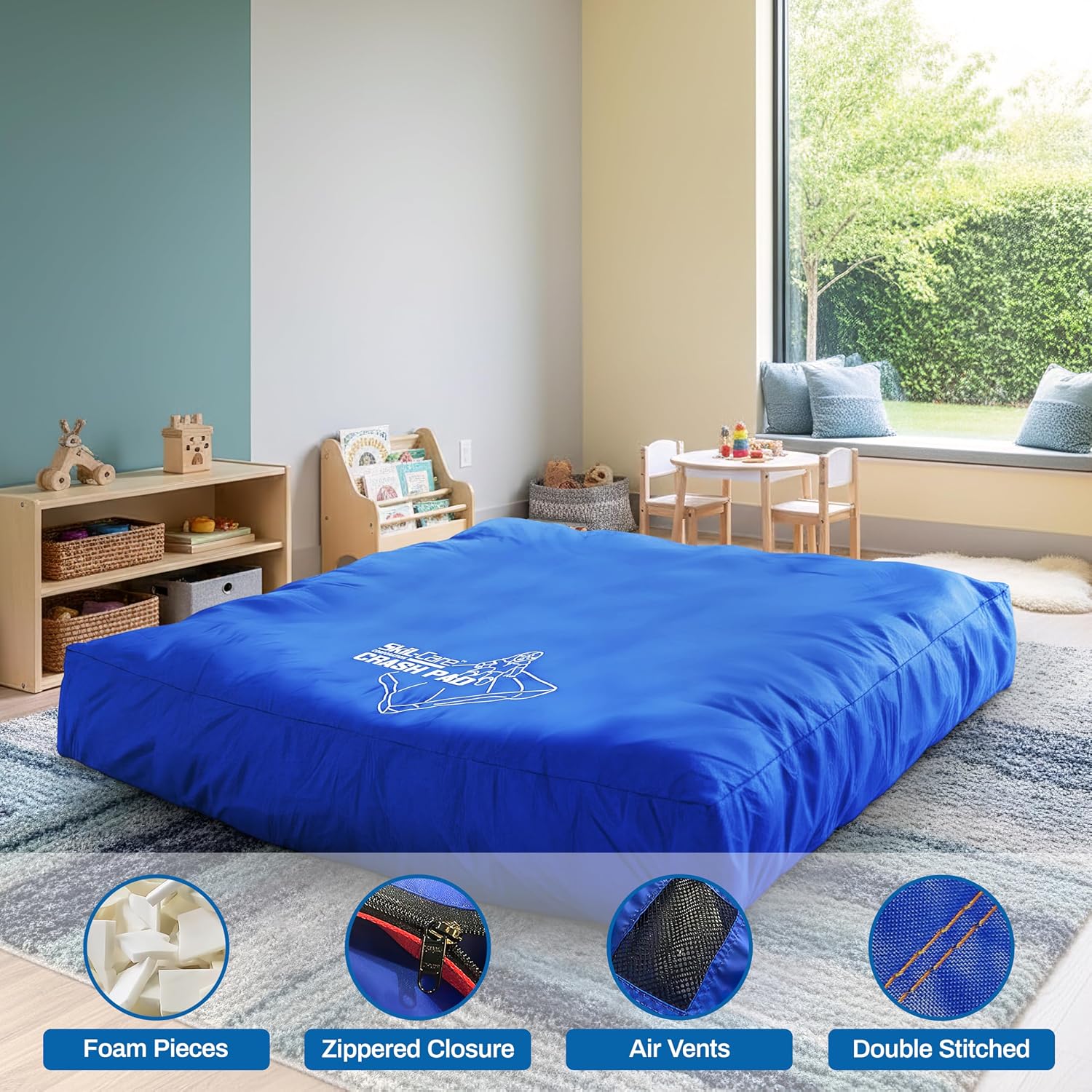
Kids who are “proprioceptive seekers” — meaning their nervous systems are constantly hungry for physical feedback about where their bodies are in space — are often the ones crashing into furniture, bear-hugging classmates too hard, or chewing through shirt collars. Proprioception (from the Latin proprius, “one’s own”) is the sense that tells your brain how much force your muscles and joints are using. When that sense is underresponsive, children seek intense input to self-regulate: crashing, pushing, pulling, carrying, squeezing. The good news is that those needs can be met deliberately and safely with the right equipment. This guide is written for practitioners and prosumer buyers — home-clinic OTs, special education coordinators, and early-intervention program managers — who are actively comparing products and need the spec-level tradeoffs, not just a product list.
| EDITOR'S PICK[Skil-Care Crash Pad for Kids](https://www.amazon.com/dp/B004NTO8T8?tag=greenflower20-20) | Mid-tier[TED KANGAROO Sensory Soft Squee…](https://www.amazon.com/dp/B0DS9GKL7L?tag=greenflower20-20) | Budget pick9 Labeled Sensory Mats w/Lesson… | |
|---|---|---|---|
| Type | Crash pad | Squeeze chair | Sensory mats |
| Material | Nylon | — | — |
| Washable | — | ✓ | — |
| Lesson plans | — | — | ✓ |
| Price | $199.99 | $79.99 | $49.97 |
| See on Amazon → | See on Amazon → | See on Amazon → |
Why Heavy Work Is the Clinical Core, Not Just the Fun Part
The AOTA’s Occupational Therapy Practice Framework, 4th Edition (OTPF-4) frames sensory processing intervention around building a child’s capacity for self-regulation. “Heavy work” — any activity that loads the joints and muscles through resistance, compression, or impact — is among the most clinically durable inputs for proprioceptive seekers because it activates the muscle spindles and Golgi tendon organs that feed the proprioceptive pathway directly. Per NCBI-indexed research by Schaaf et al. (2014), sensory integration intervention that includes structured proprioceptive activities shows measurable improvements in goal attainment for children with autism over usual care.
What practitioners are often underserved on is the equipment side: what gear actually delivers that input at a spec level appropriate for the weight, age, and context (clinical vs. home vs. school). That’s the gap this guide closes.
Crash Pads: What Specs Actually Matter
A crash pad — a thick foam-filled mat, usually with a durable nylon or vinyl cover, designed for repeated full-body impact — is the workhorse of the proprioceptive toolkit. When a proprioceptive seeker throws themselves onto a surface, the foam’s resistance delivers a full-body joint-loading event. The quality of that input depends on three spec variables that are frequently misrepresented or omitted in vendor listings.
1. Foam Density and ILD (Indentation Load Deflection) ILD measures how firm foam is — specifically, how many pounds of force are needed to compress a 50-square-inch sample by 25%. A crash pad with ILD too low (under 25 ILD) will bottom out under a heavier child, eliminating the resistance feedback; one with ILD too high (above 45 ILD) won’t compress enough to absorb impact safely. The target window for therapeutic crash pads serving children 40–120 lbs is generally 28–38 ILD, using 1.8 lb/ft³ or higher density foam. Manufacturer spec sheets from vendors like FlagHouse and TFH Special Needs typically list foam weight (density) but not always ILD — ask before purchasing for clinic or school use.
2. Cover Durability: Denier Rating and Seam Construction A denier rating describes how thick and abrasion-resistant the fabric is. For home use, 420D nylon is acceptable. For a school or clinic environment with daily use and washing cycles, insist on 600D or higher. Seam construction matters as much as fabric: double-stitched, reinforced corners will outlast single-stitched covers by 18–24 months in high-use settings, per aggregated OT equipment reviews compiled at sites like TFH Special Needs’ institutional product pages.
3. Sizing for Therapeutic Intent A 4×4-foot crash pad is the minimum functional size for intentional crashing — smaller mats are landing mats, not true crash targets. For a school sensory room with multiple users, 4×6 or 5×6 feet is the practical standard. Understood.org’s proprioception resource notes that the setup should support a “safe-falling zone” where the child can aim and land without fear of missing — the mat needs to be large enough that misses are rare.
By the Numbers: Crash Pad Tiers
| Tier | Typical Spec | Price Range | Best Fit |
|---|---|---|---|
| Home / Entry | 420D, 28–32 ILD, 4×4 ft | $80–$160 | One child, light-to-moderate use |
| Prosumer / Clinic | 600D, 32–38 ILD, 4×6 ft | $200–$380 | Private-practice OT, pediatric daycare |
| Institutional | 900D vinyl, 36–40 ILD, 5×6+ ft | $400–$700 | School sensory room, hospital PT |
Foam Rollers: Not the Same as the Adults’ Recovery Tool
Therapeutic foam rollers in pediatric sensory work are larger in diameter (6–8 inches, vs. the 4–6 inch standard used in adult exercise), softer (28–36 ILD range), and longer (24–36 inches for children who drape across them) than what you find in a general sporting goods aisle. The clinical use cases cluster into three patterns:
- Prone rolling (child lying face-down across the roller while the OT or parent rocks them): delivers deep pressure to the anterior trunk while loading the shoulder girdle
- Barrel rolling (child prone, using arms to walk hands forward while the roller moves under the torso): a heavy-work upper-body resistance task
- Joint compression wrapping (rolling along limbs with moderate pressure): used for joint input in children who need it in preparation for fine-motor tasks
The spec that most home buyers miss is foam compression recovery. Cheap EVA foam (the standard exercise-roller material) permanently compresses with daily use within 3–6 months under a child’s body weight. Closed-cell polyethylene foam, which most therapeutic-grade rollers use, maintains shape under repeated loading. Abilitations and Fun and Function both publish material composition for their therapeutic rollers; it’s worth verifying before a bulk school purchase.
Load caution: Foam rollers are not swing-rated or suspension equipment, and their load ratings are compressive, not dynamic. The frequent confusion of static and dynamic load ratings that applies to therapy swings applies here too: a roller rated to “support 200 lbs” means static compression, not that a child can drop body weight onto it with impact force. For crash/impact use, always redirect to a crash pad.
Heavy-Work Equipment Beyond Crash Pads: Resistance Tools for Home and School
Proprioceptive input doesn’t require dedicated sensory-room hardware. A well-designed heavy-work toolkit for a child’s bedroom, a classroom sensory corner, or a private-practice waiting area can be assembled from a short list of items:
Resistance Tunnels and Body Socks Lycra-based body socks (full-body stretch garments the child crawls inside) deliver circumferential proprioceptive input — the fabric’s resistance creates joint loading as the child pushes against it. Autism Speaks’ sensory issues resource hub describes them as among the most portable “input-on-demand” tools for proprioceptive seekers. Spec check: a child-size body sock should have 4-way stretch fabric with at least 150% elongation — anything stiffer than that resists movement rather than providing regulated resistance.
Weighted Lap Pads and Compression Vests (Not Weighted Blankets) For in-seat proprioceptive input during desk work, a weighted lap pad (typically 1–3 lbs) or compression vest delivers joint input without the full-body heat and immobility of a weighted blanket. The IDEA Partnership’s 2023 guidance on school-based OT tools notes that these are among the most consistently requested items in IEP sensory diet plans for proprioceptive seekers. Sizing note: 10% of body weight is a common starting point for weighted tools, but this is a ceiling, not a target — start lower (5–7%) and grade up.
Resistance Bands and Theraband Loops Secured to desk legs or chair rungs, resistance bands allow isometric pushing and pulling at the hip and knee — invisible heavy work a child can do during class. Fun and Function’s institutional catalog lists loop-resistance levels by color-coded force rating (consistent with standard Theraband convention: yellow = lightest, blue = heavy). For school procurement, buy by force level, not brand, and verify the chair/desk mount point can handle repetitive lateral load without loosening.
Pull-Along Weighted Carts and Backpacks Loading a child with 10–15% of their body weight in a well-fitted backpack or pull cart is one of the simplest heavy-work inputs for hallway transitions at school. The load must be evenly distributed (bilateral carry) and the weight must be confirmed against the child’s current weight regularly — children gain weight, and a bag filled six months ago may now exceed safe ratios.
Institutional Procurement: Where Practitioners Lose Money
If you’re specifying heavy-work equipment for a school district or pediatric clinic under IDEA or ARP funding, the pricing dynamics in mid-2026 reward consolidation but punish inattention. FlagHouse, Abilitations (now under the School Specialty umbrella), and TFH Special Needs are the three dominant institutional vendors — and as the IDEA Partnership has noted in its school-OT guidance, the consolidation of these suppliers over the past five years means list prices have drifted upward while the number of competitive quotes available has shrunk.
Practical procurement rules for current conditions:
-
Require ILD and density on the spec sheet for any foam product before issuing a PO. Vendors are not required to publish this proactively; requiring it filters out commodity products resold with therapeutic branding.
-
Quote the same SKU from FlagHouse, Abilitations, and a direct-from-manufacturer source (such as Bailey Manufacturing or Southpaw Enterprises for therapy-specific items). Institutional list prices in the 2025–2026 cycle are running 15–30% higher than equivalent direct-manufacturer pricing on large-foam items.
-
Bundle crash pads with sensory room furniture when possible. School Specialty’s volume-tier pricing breaks at $2,500 and $5,000 — if your crash pad order is $1,800, adding $700 in foam rollers and resistance tools may move you to the next tier and net savings overall.
-
Clarify warranty terms for institutional use. Most crash pads and foam rollers carry warranties that void under “commercial use” unless the institutional version is explicitly purchased. Residential-grade products showing up on school purchase orders have been denied warranty claims — a documented pattern noted in OT listservs and practitioner forums over the past two procurement cycles.
Decision Rules: If X, Then Y
If your client is a single child at home, weight under 60 lbs: A 4×4 crash pad in the $80–$140 range with 420D cover is sufficient. Add a body sock and one resistance band loop for a complete home toolkit under $200.
If you’re equipping a private-practice or home-clinic OT room: Invest in the 600D, 4×6 format crash pad ($220–$350). The cover durability and size justify the premium across dozens of clients. Add a therapeutic-grade foam roller (closed-cell PE, not EVA) and a set of Theraband loops graded by resistance level.
If you’re writing a school sensory room spec under IDEA funding: Specify 900D vinyl institutional crash pads, require foam density and ILD on the PO, get three vendor quotes (FlagHouse, Abilitations, and one direct manufacturer), and bundle to hit volume pricing thresholds. Allocate 15–20% of the crash pad/foam-roller line item for annual replacement of covers and compression-fatigued foam — this is consistently the line item that disappears from first-year budgets and creates equipment failure in year two.
If the proprioceptive seeker is also a sensory avoider in other domains: Heavy-work tools are generally well-tolerated even in mixed-profile kids, but body socks and compression vests require individual titration. Start with shorter wear times (5–10 minutes) and observe for arousal increase rather than decrease — a minority of children show paradoxical response, as documented in NCBI-indexed sensory integration literature. Involve the supervising OT before committing to compression tools in this population.
The equipment itself is the easy part. The clinical judgment — right tool, right dose, right moment — is yours. These specs just make sure the gear doesn’t fail before the intervention does.