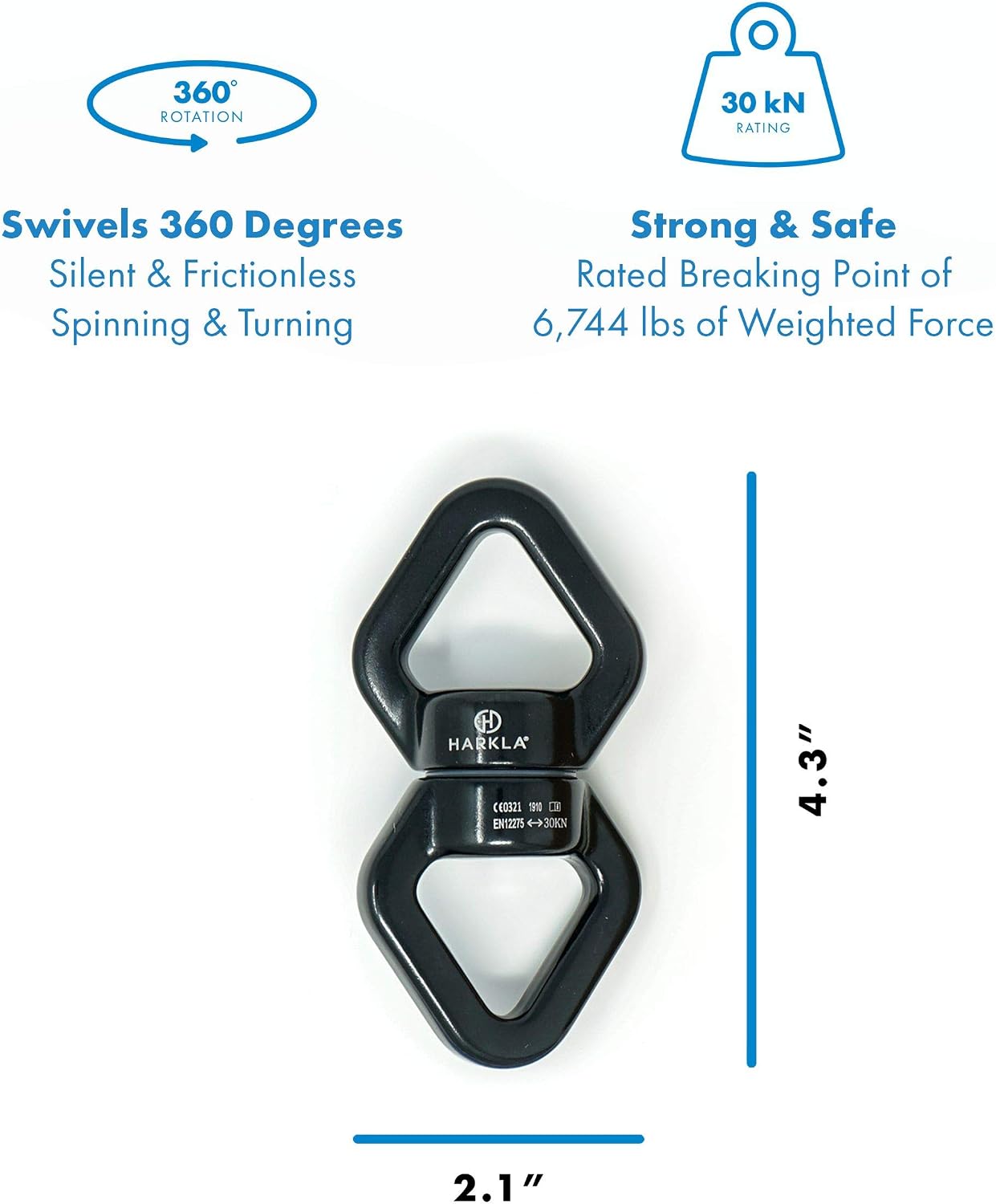
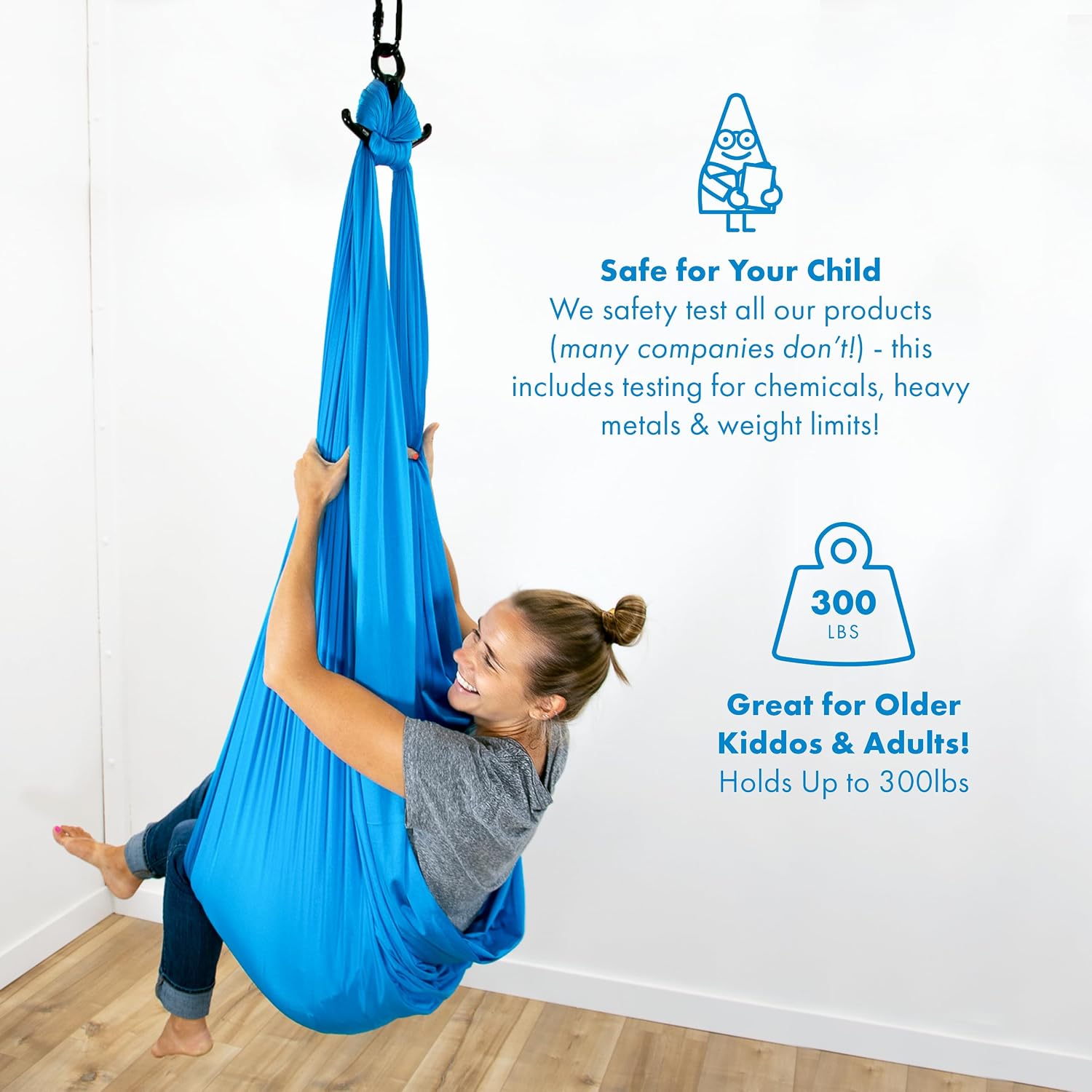
A sensory swing’s weight rating — the number printed on the box or listed in a product description — tells you how much weight the swing is designed to hold while it is sitting perfectly still. That is the static load rating: a measure of dead, motionless weight. But a child in a sensory swing is never motionless. They twist, bounce, drop in suddenly, and pump their legs. Every one of those movements multiplies the real force on the hardware far beyond the child’s body weight. That multiplied, movement-generated force is what engineers call the dynamic load — and most consumer-facing swing listings do not show it. When those two numbers are confused, the consequences range from a bent carabiner to a ceiling joist pulled clean out of the framing. This guide breaks down exactly what both ratings mean, how to find them, and how to match the right spec to your clinical or home setting before anything fails.
Why the Difference Between Static and Dynamic Load Is Bigger Than It Looks
Here is the math that makes this concrete.
A child who weighs 60 lb (27 kg) climbing gently into a hammock swing applies something close to 60 lb of static load. That same child dropping into the swing from even a few inches generates a peak impact force that can reach two to four times their body weight, depending on drop height, swing stiffness, and deceleration rate. At the high end of a vigorous arc — think a determined eight-year-old with proprioceptive-seeking behavior pumping hard at the end of the pendulum stroke — the instantaneous tension on the suspension hardware can spike to three or more times the static weight.
By the numbers:
| Scenario | 60 lb child | Estimated peak load on hardware |
|---|---|---|
| Sitting still in swing | 60 lb | ~60 lb (1× static) |
| Gentle climbing-in drop | 60 lb | ~90–120 lb (1.5–2×) |
| Active pumping at arc apex | 60 lb | ~150–180 lb (2.5–3×) |
| Hard drop-in from standing | 60 lb | ~180–240 lb (3–4×) |
A swing marketed as “holds up to 150 lb” using a static rating could, under real therapeutic use with an active child, be absorbing dynamic peaks at or above that same 150 lb ceiling — with no safety margin remaining. ASTM International standards F1292 and F2223 (impact attenuation and equipment specifications for public play and therapy areas) incorporate dynamic load considerations precisely because static ratings alone have consistently underrepresented real-world stress in both playground and therapy contexts.
This is not a theoretical edge case. Occupational therapy practice literature — including guidance published by the American Occupational Therapy Association in their Occupational Therapy Practice Guidelines for Children and Adolescents with Sensory Integration Dysfunction (AOTA Press) — consistently flags equipment failure as an outcome of mismatched load specifications, particularly when proprioceptive-seeking children use vestibular equipment at the high-intensity end of their therapeutic range.
How Manufacturers Report (and Sometimes Obscure) These Numbers
The problem is not always dishonesty — it is inconsistency in how the industry presents ratings. Reviewing 2024–2026 catalog data from major institutional suppliers reveals three distinct presentation patterns.
Budget-Tier Pattern: Single Figure, Methodology Unstated
This is the most common approach in consumer-grade and lower mid-tier listings. A swing says “supports up to 200 lb.” You do not know whether that 200 lb is a static test load, a dynamic test load, or a manufacturer’s self-assessed estimate. This pattern dominates lower-priced segments and general-marketplace listings where no testing standard is cited.
The practical risk: A family purchasing a budget swing for a 70 lb child who is an active sensory seeker and seeing “150 lb capacity” with no further detail may be operating near or above the real dynamic working limit from day one. The FlagHouse Adapted Physical Education and Sensory catalog (2025–2026 edition) explicitly distinguishes its consumer-line from its commercial-line products on this basis, noting that single-figure consumer listings do not carry the same testing documentation as their institutional offerings.
 product image](/images/external/94d416644c91.jpg)
OUTREE
$39.99
In stock on Amazon
Check price on AmazonMid-Tier Pattern: Working Load Limit Stated, Safety Factor Implied
At the mid-tier, better-documented products begin to report a working load limit (WLL) — a figure that already incorporates a safety factor against the dynamic test load, typically 4:1 or 5:1. A swing system rated at a 250 lb WLL with a 5:1 safety factor has been test-loaded to 1,250 lb before the rating is set. That is a fundamentally different product than a consumer swing with a single, unverified 250 lb figure.
Southpaw Enterprises’ therapy swing hardware product specification sheets (2024 catalog) distinguish between the static load rating of the suspension hardware and the WLL in this way, and recommend that practitioners treat the WLL — not the static rating — as the relevant capacity figure for clinical use. This is the standard that separates mid-tier clinical products from consumer-grade alternatives sold into the same retail channels.
The practical implication for buyers: If a product page says “working load limit” or “WLL” and gives a specific number alongside a stated safety factor, you are looking at mid-tier documentation standards. If those terms are absent, you are not.
 product image](/images/external/af4ba2f77b98.jpg)
Marlowe
$89.99
In stock on Amazon
Check price on AmazonPremium/Institutional Pattern: Full Suspension Chain Documentation
At the premium end — commercial sensory room build-outs, pediatric hospital installations, school district procurement — every component in the suspension chain carries its own rated WLL, and the manufacturer supplies engineering documentation on request. TFH Special Needs’ Swing and Suspension Hardware Safety Guide (UK/US editions, 2025) specifies that institutional-grade hardware documentation should address each link in the chain: swing attachment point, swivel, connector hardware, and ceiling anchor, each with its own WLL and the test methodology used to derive it.
At this tier, the hardware spec is not a single number on a product listing — it is a document. The cost gap between mid-tier and premium institutional hardware is typically $50–$120 per swing point. The liability gap, particularly under IDEA-funded procurement where the district bears responsibility for equipment failures, is not comparable.
The IDEA Partnership’s guidance on accessible school environments and durable medical equipment notes that therapeutic equipment procured under IDEA funding carries the district’s liability if it fails — making the vendor’s rating methodology as important as the number itself.
Harkla
$99.99
In stock on Amazon
Check price on AmazonA Note on Breaking Strength vs. Working Load Limit
One specific documentation pattern deserves its own section because it causes the most dangerous misreads in the consumer market.
Some hardware — particularly carabiners and quick-links imported for general outdoor use and re-marketed for therapy swing kits — lists only breaking strength, with no WLL stated. Per TFH Special Needs’ Swing and Suspension Hardware Safety Guide (2025 edition), breaking strength should never be treated as a usable working load. Standard practice in rigging engineering is to divide breaking strength by a safety factor of 5 to 10 before treating it as a working limit for active, dynamic loading conditions.
A carabiner listed at “550 lb breaking strength” is therefore not appropriate for loads above 55–110 lb in active swing use. That same carabiner appears in a substantial portion of the consumer sensory swing kits currently on the market, often at a unit cost under five dollars.
The decision rule: If a component in your suspension chain lists only breaking strength, divide that number by 5 before treating it as a real-world capacity figure for active pediatric use. If the resulting number is below your dynamic load estimate (child’s weight × 3 for an active sensory seeker), replace the component with one that carries a documented WLL.
Matching Spec to Setting: The Decision Framework
Home Use, Parent-Purchased, Single Child
For a family buying a first sensory swing — a compression swing, pod swing, or platform swing for indoor home use — the key questions are:
- Is a dynamic load or working load limit stated anywhere in the product documentation?
- Is the child’s weight under 50% of the stated capacity (whatever methodology)?
- Is the ceiling anchor rated independently, and is it installed in structural framing — not drywall?
If all three answers are yes, most mid-tier swings from established occupational therapy suppliers carry acceptable real-world risk for typical home use. If the weight capacity figure is unexplained and the child is an active, high-intensity sensory seeker, increase the capacity buffer significantly: treat an unverified “150 lb capacity” listing as suitable for no more than a 50–60 lb child.
Prosumer and Private-Practice Settings
At this tier, the swing sees multiple users per day across a wide weight and activity range. The decision rule is: if you cannot locate a working load limit with a stated safety factor for every component in the suspension chain — swing attachment point, swivel, connector hardware, ceiling anchor — do not install the system for clinical use.
The American Occupational Therapy Association’s Occupational Therapy Practice Guidelines for Children and Adolescents with Sensory Integration Dysfunction (AOTA Press) frames equipment safety infrastructure as a prerequisite for therapeutic vestibular intervention, not a secondary consideration. That framing applies to the hardware specification, not just to the clinical protocol.
Institutional Settings: School Districts, Pediatric Hospitals, Sensory Room Build-Outs
At the $5,000–$15,000 sensory room build-out level — where procurement officers are specifying under IDEA or ARP funding and comparing bids from vendors including FlagHouse, Abilitations, and School Specialty — load ratings belong in the RFP language itself.
Recommended RFP specification language (adapt as needed):
- “All swing suspension hardware shall carry a minimum 4:1 working load limit to dynamic test load, independently documented by the manufacturer.”
- “Static load ratings alone are not acceptable as the primary capacity specification.”
- “Ceiling mount anchors shall be rated to the same WLL as the swing hardware and installed per the manufacturer’s structural requirements.”
Comparing bid responses on this specific language will reveal which vendors are supplying commercial-grade systems versus reselling consumer equipment at institutional pricing. The vendor who cannot provide a dynamic WLL with a stated safety factor for their suspension hardware is selling the wrong product for this setting.
What to Check in the Suspension Chain
Even a properly rated swing can fail at the weakest link in its suspension chain. The American Academy of Pediatrics, in their 2012 Pediatrics journal review of sensory integration therapies (“Sensory Integration Therapies for Children with Developmental and Behavioral Disorders”), notes that equipment safety infrastructure is a prerequisite for therapeutic use — and that infrastructure means the complete system, not just the labeled product.
Every suspension chain has at least four components, each requiring its own rating check:
- The swing attachment point — the loop, ring, or bar sewn or molded into the swing itself. Fabric attachment points on lower-cost swings are often the lowest-rated element in the chain.
- The swivel — if present. Southpaw Enterprises’ therapy swing hardware specification documentation recommends ball-bearing swivels with a minimum 5:1 safety factor for all active vestibular swing applications.
- The connector hardware — carabiner, snap hook, or quick-link. Look for screw-lock or auto-lock carabiners rated to a WLL, not a burst or breaking strength figure only.
- The ceiling anchor and structural connection — the point where every load ultimately resolves. No swing hardware rating matters if the anchor is a toggle bolt into drywall. Structural joist, beam, or dedicated swing beam installation is non-negotiable for active use.
If X, Then Y: The Decision Rules
If the product listing shows only a single weight capacity number with no methodology: Treat it as a static estimate. For an active child, use no more than 40–50% of that number as your real working limit.
If you are specifying for institutional or clinical use: Require a documented WLL with a safety factor of at least 4:1. Do not accept breaking-strength figures as a substitute.
If a child is a high-intensity proprioceptive seeker who drops hard into the swing and pumps aggressively: Apply a 3× multiplier to their body weight when evaluating whether a swing’s capacity is sufficient, regardless of what the label says.
If you are comparing vendor bids for a sensory room: Ask each vendor to specify the dynamic WLL for the suspension hardware, separately from the swing’s stated weight capacity. The vendor who cannot answer is selling consumer equipment into an institutional context.
If the ceiling anchor methodology is unspecified in a contractor’s proposal: Stop the project until structural attachment is confirmed in writing. This is the point of failure that causes the most serious injuries, and it is the one most commonly left to assumption.
The number on the swing box is a starting point. The load rating that actually protects a child — and the adults responsible for that child’s safety — is the one that accounts for what the child is going to do in it.