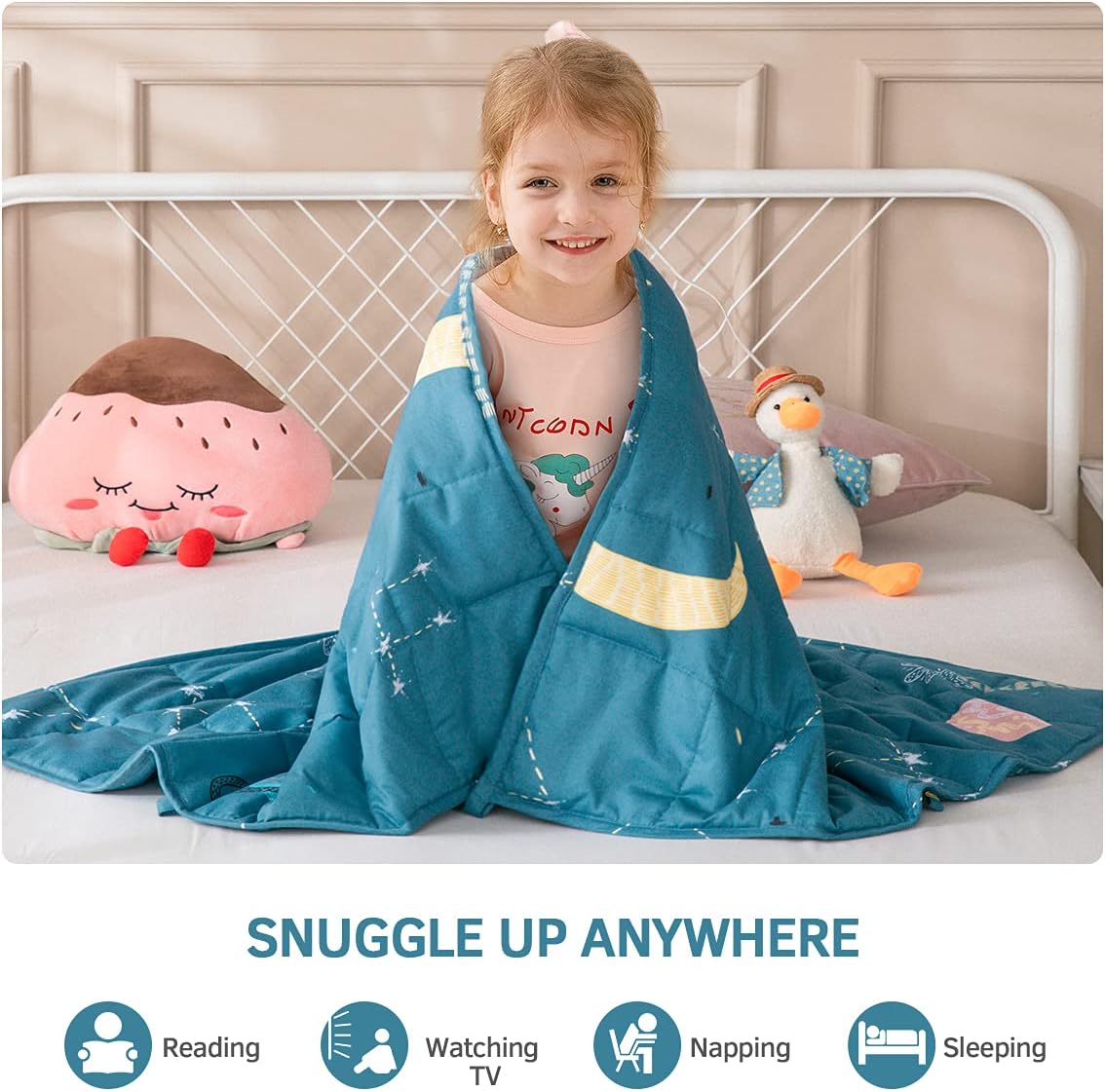
You’ve probably seen it on product packaging, in school district spec sheets, and in vendor catalogs: “Choose a blanket that weighs 10% of the child’s body weight.” It’s tidy, repeatable, and easy to explain to a parent at a school meeting. A weighted blanket is exactly what it sounds like — a blanket filled with small weights (usually glass beads or plastic pellets) distributed evenly across its surface, designed to apply gentle, even pressure to the body. That pressure activates what occupational therapists call deep pressure touch stimulation (DPTS) — essentially the calming sensation you get from a firm hug — which many children with autism, ADHD, or sensory processing differences find regulating. The 10% rule is the field’s shorthand for selecting a blanket heavy enough to deliver that effect without creating risk. It’s useful. It’s also incomplete in ways that can matter clinically, legally, and for your client’s outcomes.
This article is for practitioners who already know what a weighted blanket does and are trying to use the guideline correctly — not just defensibly. We’ll cover where the rule came from, which populations it undershoots or overshoots, and how to structure your recommendation so it holds up to parent questions, administrator review, and your own liability standards.
| EDITOR'S PICK[Dreamland Baby 4lb Weighted Bla…](https://www.amazon.com/dp/B0F5D9QW9K?tag=greenflower20-20) | Mid-tier[MAXTID Weighted Blanket for Kid…](https://www.amazon.com/dp/B07MQT2C4F?tag=greenflower20-20) | Budget pick[Sivio Weighted Blanket - All-Na…](https://www.amazon.com/dp/B0FF9275WB?tag=greenflower20-20) | |
|---|---|---|---|
| Weight | 4lb | 5lbs | 5 lbs |
| Dimensions | — | 36"x48" | 36 x 48 inches |
| Material | Dual Fabrics | Cotton | 100% Cotton |
| Washable | — | — | ✓ |
| Cooling Side | ✓ | — | — |
| Age Range | — | 3-8+ Year | — |
| Price | $109.00 | $39.99 | $26.59 |
| See on Amazon → | See on Amazon → | See on Amazon → |
Where the 10% Rule Actually Comes From — and What It Was Never Designed to Do
Let’s be direct: the 10% guideline is not a clinical standard derived from randomized controlled trials. It is a widely adopted heuristic — a rule of thumb — that emerged from occupational therapy practice and has been repeated so frequently it has acquired an authority the underlying evidence doesn’t fully support.
The American Occupational Therapy Association (AOTA), in its evidence-based practice resources on weighted blanket use, acknowledges that while weighted modalities show promise as regulatory tools, the research base remains limited and heterogeneous. Published systematic reviews through 2025 consistently note that study samples are small, outcome measures vary, and dosing protocols (including weight selection) are rarely standardized across trials. The AOTA’s position does not endorse a single percentage-based formula as clinically validated.
What practitioners are actually using when they cite “10%” is a safety-first consensus norm — not a dosage protocol. It originated partly as a ceiling to prevent practitioners from recommending blankets that could restrict breathing or circulation, particularly in clinical contexts where children might be non-verbal or have limited motor ability to remove a blanket. In that sense, it is a harm-reduction rule masquerading as a therapeutic dosing rule. That distinction matters enormously when you’re trying to explain why a particular child isn’t responding, or why a seemingly compliant recommendation is producing adverse reactions.
The Four Clinical Situations Where 10% Fails as a Sole Criterion
1. Young Children and Low Body Weight
The math breaks down fastest at the low end. A 30-pound (roughly 14 kg) child at 10% yields a 3-pound blanket — and commercial weighted blankets rarely come in weights below 5 lbs. The practical result: families and therapists default to the lightest available product, which may still exceed a safe proportion for a toddler or small preschooler.
More importantly, young children have proportionally lower respiratory muscle strength and less ability to self-rescue (move a blanket off themselves) than older children. The American Academy of Pediatrics has historically restricted weighted sleep products for infants entirely based on suffocation risk, and the precautionary logic extends into early childhood. Understood.org’s guidance on weighted blankets for kids explicitly flags that children under age 3 should not use weighted blankets without direct OT supervision, and that weight should be introduced conservatively regardless of the 10% math.
The practitioner takeaway: For children under 6, or any child under approximately 40 lbs, treat 10% as a ceiling to approach cautiously — not a target to hit.
2. Seizure Disorders
This is the highest-stakes exception and the one most likely to create liability if overlooked. Children with active or poorly controlled seizure disorders present unique risk under a weighted blanket: if a seizure occurs while the blanket is in use, the child may be unable to move it, and the added weight can impair respiratory function during a postictal (post-seizure) recovery phase.
Neither 10% nor any percentage-based formula addresses this risk, because the risk is not about weight magnitude — it is about the child’s ability to self-rescue during a medical event. AOTA’s practice guidelines recommend that for children with seizure diagnoses, weighted interventions require explicit physician clearance and should generally not be used unsupervised, regardless of weight selection.
The practitioner takeaway: Weight percentage is the wrong variable here. The question to answer first is whether unsupervised weighted blanket use is contraindicated at all.
3. Sensory Avoiders
This one is counterintuitive enough that it catches even experienced practitioners off guard. The assumption behind weighted blankets is that the child is a sensory seeker — someone who under-registers tactile and proprioceptive input and needs more of it to feel regulated. But a meaningful subset of children with sensory processing differences are sensory avoiders — they over-register sensory input and respond to it with distress or dysregulation.
For a sensory avoider, a weighted blanket — even one correctly sized at 10% — can be aversive. The child may tolerate it initially due to compliance or novelty, then show increased anxiety, behavioral escalation, or refusal over subsequent sessions. CHADD’s overview of sensory processing and ADHD notes that sensory profiles in ADHD are highly heterogeneous; many children present with mixed seeking-and-avoiding patterns that shift by context.
The practitioner takeaway: Sensory profile assessment — not weight calculation — is the prerequisite step. If you’re starting with the weight before you’ve confirmed the child is a seeker rather than an avoider, you’ve inverted the clinical process.
4. Children with Low Muscle Tone (Hypotonia)
Children with diagnoses that include hypotonia (low muscle tone — meaning muscles that are weaker and less firm than typical, which affects posture, movement, and endurance) may fatigue rapidly under a weighted blanket even at technically “appropriate” weights. The additional proprioceptive input that regulates a typically-toned child can be exhausting for a hypotonic child, particularly during fine motor or seated tasks. A blanket that should be calming becomes physically taxing.
This is documented in occupational therapy literature through functional outcome observation rather than controlled trials — practitioners consistently report shorter tolerance windows and earlier signs of fatigue in this population. Autism Speaks’ sensory issues resources acknowledge that sensory profiles in autism (where hypotonia is common) vary substantially and require individualized calibration.
By the Numbers: A Quick Reference for Weight Decision-Making
| Child weight | 10% target | Likely commercial minimum | Practical risk flag |
|---|---|---|---|
| Under 30 lbs | < 3 lbs | 5 lbs | Commercial blanket exceeds 10% — supervise closely |
| 30–50 lbs | 3–5 lbs | 5 lbs | Borderline; confirm seeker profile before use |
| 50–80 lbs | 5–8 lbs | 5–7 lbs | Standard range; 10% rule most applicable here |
| 80–120 lbs | 8–12 lbs | 10–15 lbs available | Add 1–2 lbs for hyposensitive seekers; reduce for avoiders |
Note: Weight ranges reflect typical commercial product availability as of mid-2026. Always verify current spec sheets with vendors, as product lines shift.
What a Defensible Recommendation Actually Looks Like
If you’re writing a recommendation — whether for a school IEP, a clinical progress note, or a home program — the weight percentage should appear as one variable inside a larger clinical rationale, not as the sole justification. Here’s the structure that holds up:
1. Sensory profile first. Document whether the child demonstrates seeking, avoiding, or mixed behaviors in the tactile and proprioceptive domains. This is the gate. If you can’t confirm seeking behaviors, you don’t have a basis for the recommendation yet.
2. Contraindication screening. Flag any of the following and document your clinical reasoning: seizure disorder, active respiratory compromise, low muscle tone, age under 3, significant anxiety around physical restraint or confinement.
3. Weight selection with rationale. State the child’s current weight, the calculated 10% figure, the selected blanket weight, and your reason for any deviation. “Selected 7 lbs rather than 8 lbs (10% of 80 lbs) due to reported hypersensitivity in lower extremities” is a complete record. “Chose 10% per standard guidelines” is not.
4. Monitoring protocol. Per AJOT-published guidance on weighted interventions, duration and response should be monitored rather than assumed stable. A 20-minute initial trial with behavioral observation is the norm in structured settings. Document what you’ll look for and when you’ll reassess.
5. Caregiver training. Understood.org and AOTA both emphasize that weighted blankets in home and school settings require caregiver understanding of removal procedures, duration limits, and signs of adverse response. Your recommendation is only as safe as the adults implementing it.
The Decision Rule: If X, Then Y
This is where the research translates into action for a practitioner with a decision pending:
-
If the child is under 40 lbs: Start below 10%, verify the lightest commercially available option, and supervise initial trials. Do not assume 10% is safe because it’s the guideline.
-
If the child has a seizure disorder: Pause the recommendation entirely until you have physician clearance. Reclassify as supervised-use only regardless of weight.
-
If the sensory profile is unclear or mixed: Run a sensory profile assessment first. Do not write a weight-based recommendation for a child whose seeker/avoider status is undetermined.
-
If the child is a confirmed proprioceptive seeker with no contraindications and weight is 50 lbs or more: The 10% rule is your reasonable starting point. Add 1–2 lbs for children who show minimal response in trials; do not exceed 15% without documented clinical rationale and physician awareness.
-
If the recommendation will go into an IEP or 504 plan: Structure your written rationale using the five-element format above. A weight percentage alone will not satisfy an administrator or parent who questions the recommendation after an adverse event.
The 10% rule isn’t wrong. It’s just not the whole job. Knowing where it applies cleanly — and where it doesn’t — is what separates a recommendation you can stand behind from one you’ll have to explain later.